

CREATE THE NEXT GENERATION OF INTELLIGENT WORKFORCE.
In early summer, on the shores of West Lake, the 2026 World Digital Education Conference officially opened in Hangzhou on May 11. Co-hosted by China’s Ministry of Education and other leading institutions, the conference is one of the world’s premier annual events dedicated to the future of education.
As a leading embodied AI company in China, Spirit AI joined forces with China Educational Instrument & Equipment Corp. (CEIEC), a key national player in the educational equipment sector, to make a joint appearance on this major national stage.
At the conference, Spirit AI presented a comprehensive vision of how embodied intelligence can empower university education and research, joining educators from around the world in exploring a new future for “AI + Education.”
Hosted by China’s Ministry of Education, the World Digital Education Conference is a premier global education event. With “AI + Education” as its central theme this year, the conference brought together government leaders, education ministers from around the world, presidents of renowned universities, and executives from leading digital technology companies.
On this influential national and international platform, Spirit AI not only demonstrated the technological capabilities of China’s embodied intelligence sector, but also deepened its collaboration with China Educational Instrument & Equipment Corp. (CEIEC), bringing industry and education closer together.
Embodied intelligence is no longer a technology confined to laboratories or abstract concepts—it is increasingly becoming deeply integrated into the education ecosystem.
Leveraging its full-stack capabilities in end-to-end embodied foundation models and robotic hardware, together with CEIEC’s extensive experience and network across educational institutions nationwide, Spirit AI is providing an integrated “technology + scenarios + data” solution for higher education institutions across China.
Together with universities and education leaders, Spirit AI aims to explore new possibilities for AI program development, research projects, and the cultivation of next-generation AI talent.
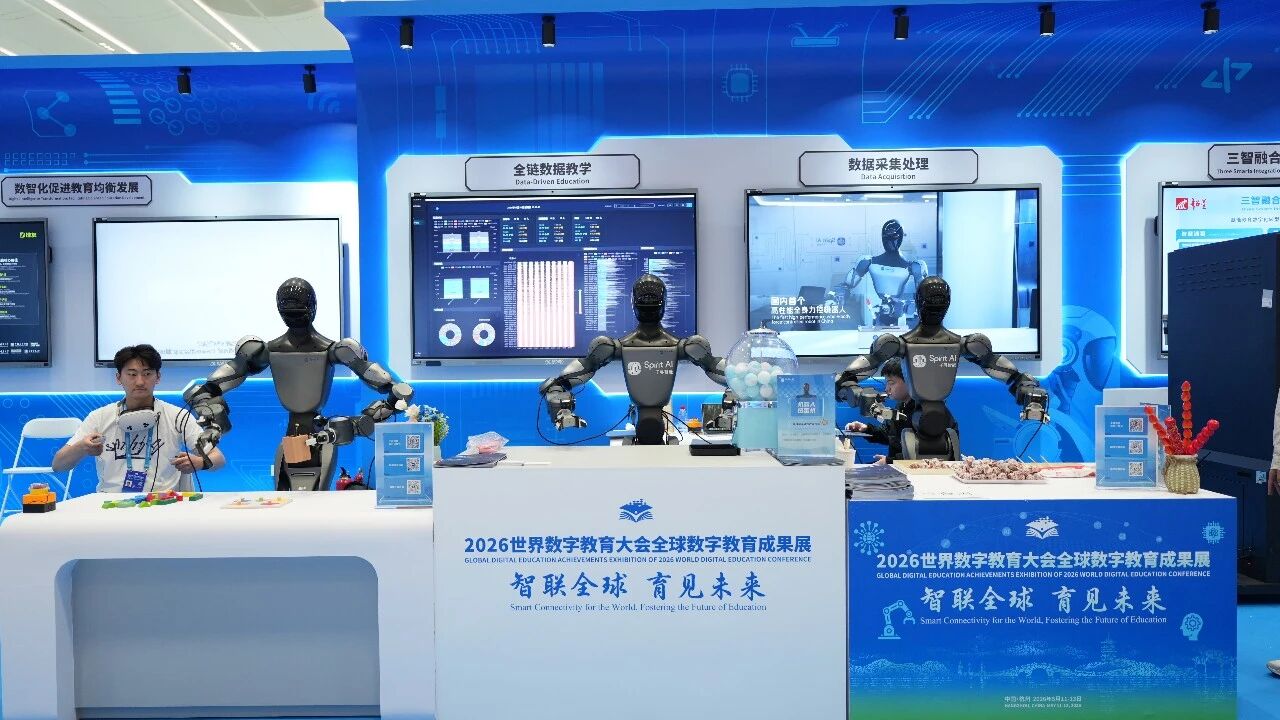
At the “AI + Education” exhibition area, Spirit AI presented its full-stack embodied intelligence technology flywheel, spanning the entire pipeline of:
Data Collection → Intelligent Annotation → Model Training → Validation → Real-World Deployment
Three Moz1 embodied humanoid robots took center stage, bringing the complete AI education and research lifecycle to life and drawing significant attention from visitors.
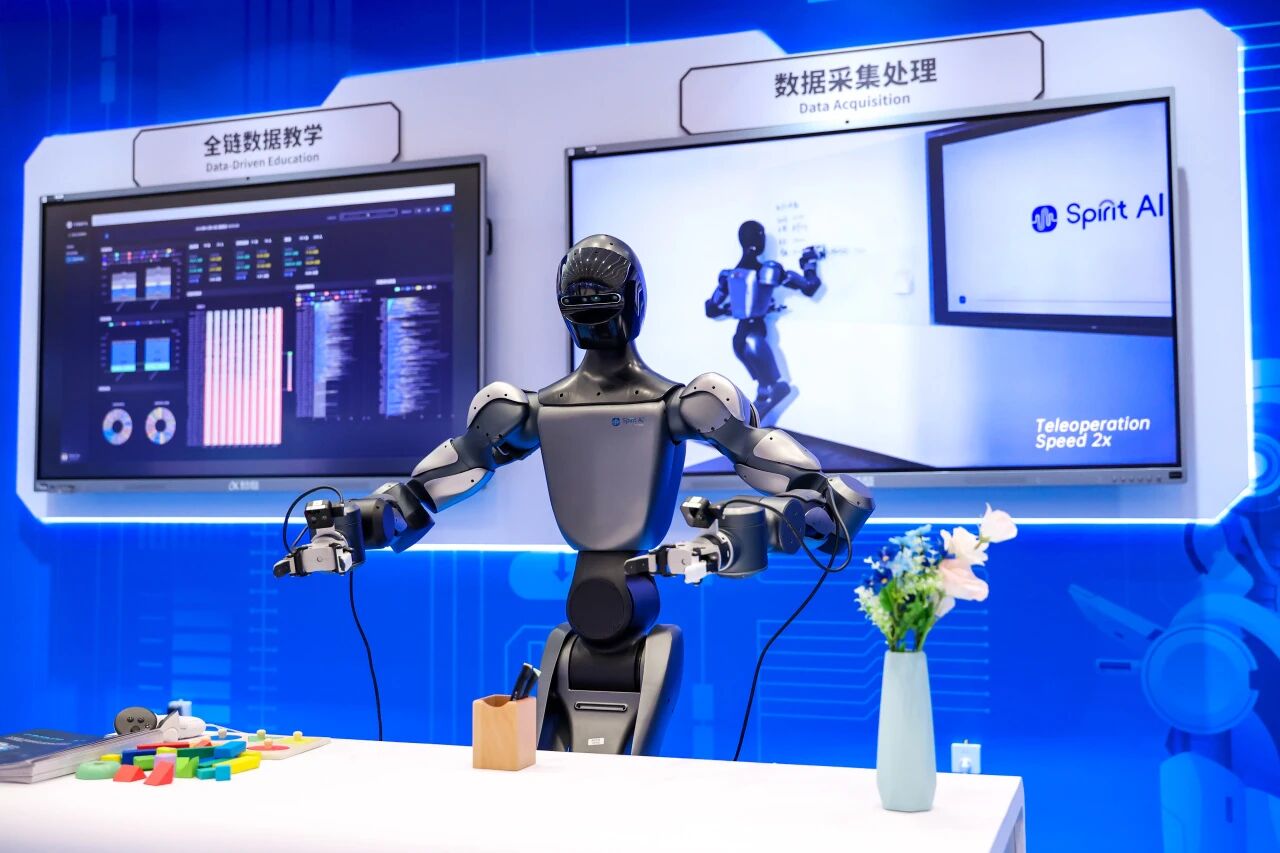
At the conference, Spirit AI showcased the foundational infrastructure behind its embodied AI research and development—an integrated system designed to accelerate the generation and utilization of high-quality research data.
At the center of the demonstration was Moz1, Spirit AI’s first commercial-grade embodied humanoid robot. Featuring 26 degrees of freedom, Moz1 is equipped with highly integrated force-controlled joints with world-leading power density, delivering industry-leading performance across speed, precision, safety, and biomimetic force control.
Another core component of the infrastructure is UDAS, Spirit AI’s proprietary high-precision, multidimensional data collection system.
Seamlessly integrated with Moz1, UDAS enables a data collection pipeline capable of hour-level iteration. Together with the Quanta data platform, visualized live on the exhibition screen, Spirit AI demonstrated the complete closed loop—from high-fidelity scene reconstruction and precise annotation to automated model training and testing.
This integrated infrastructure provides universities with a robust foundation for embodied AI research while supporting the continuous generalization and evolution of foundation models across complex environments and multimodal tasks.
Meanwhile, two Moz robots demonstrated their capabilities in generalized decision-making and autonomous reasoning.
Both robots were powered by Spirit v1.5, Spirit AI’s proprietary embodied foundation model. As an end-to-end Vision-Language-Action (VLA) model, Spirit v1.5 enables robots to understand dynamic environments, make autonomous decisions, and form a human-like closed loop of perception, understanding, and execution.
Through real-time end-to-end inference, the model moves beyond preset scripts and hard-coded rules, allowing robots to operate flexibly in uncontrolled, open environments.
At the exhibition, Moz smoothly prepared tanghulu (candied fruit skewers) for visitors and autonomously interacted with a capsule toy machine.
Its end-to-end generalization capabilities extend far beyond individual demonstrations. Moz can also perform continuous, long-horizon tasks such as organizing desktops, disposing of trash, and returning chairs to their proper positions.
These capabilities demonstrate the model’s ability to understand complex physical dynamics and make decisions across long action sequences, while continuously improving the robot’s adaptability to real-world applications.

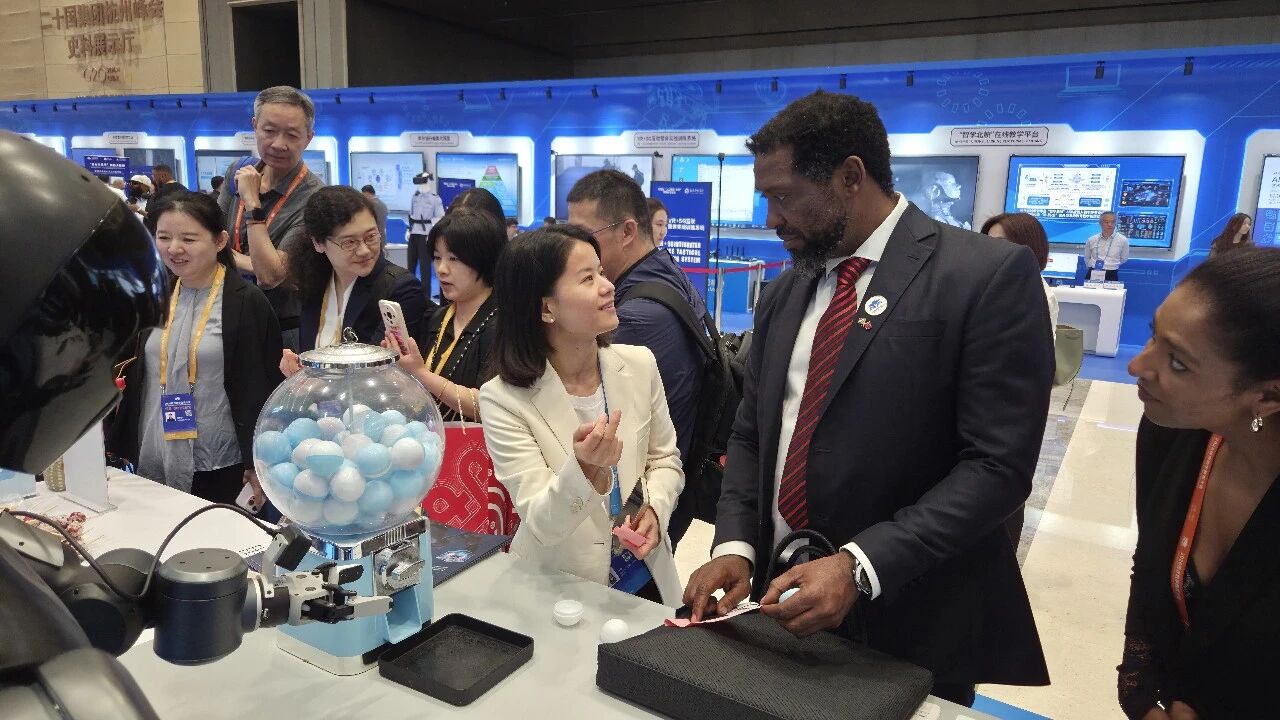
The teleoperation experience quickly became one of the most popular attractions at the Spirit AI booth, giving visitors hands-on access to a high-precision robotic teleoperation system powered by multimodal motion capture.
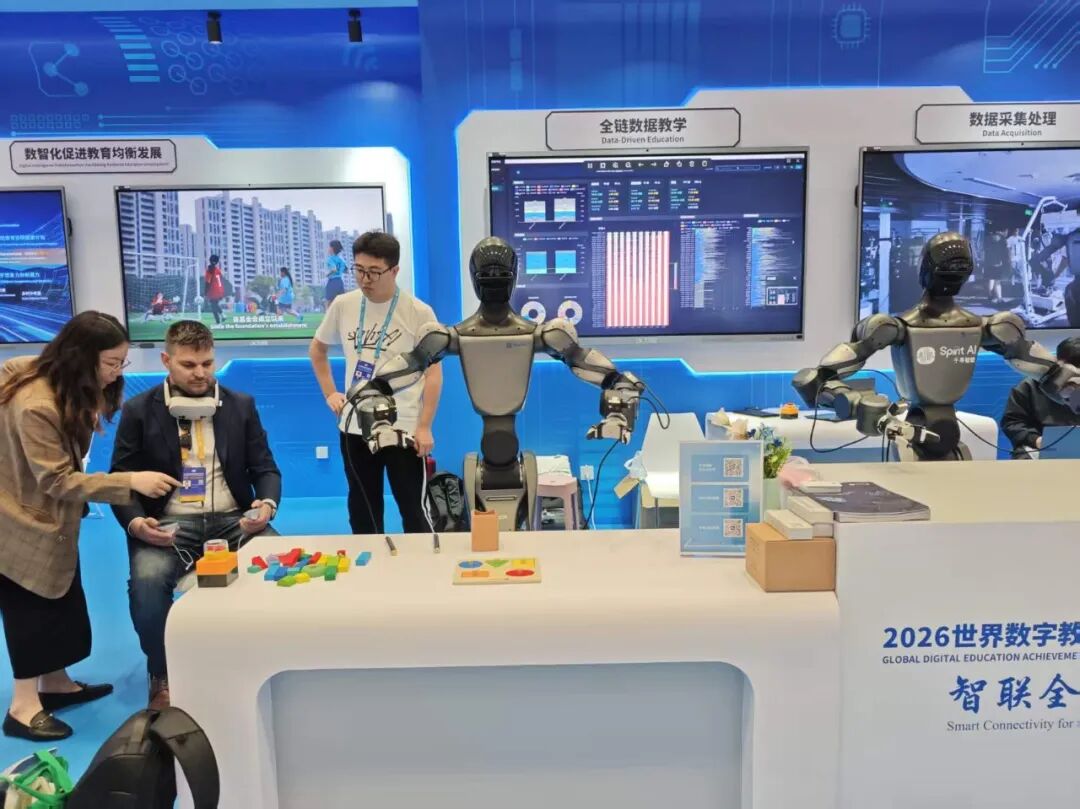
Visitors could directly control Moz themselves.
Equipped with Spirit AI’s high-precision, high-frequency WBC (Whole-Body Control) algorithm, Moz combines a high-frequency low-level control loop with precise multidimensional pose mapping to achieve smooth human-robot synchronization with millisecond-level latency.
The result is an intuitive sense of controlling the robot almost as an extension of one’s own body.
Visitors could experience this firsthand by guiding Moz through fine-grained manipulation tasks such as stacking blocks and Pick & Place Anything.
Even amid the complexity and unpredictability of real-world interaction, Moz remained smooth and responsive, demonstrating the strong robustness of Spirit AI’s underlying technology in handling high-frequency dynamic interactions and changing physical environments.
Education is a bridge to the future, while embodied intelligence is poised to become a key foundation for the next generation of intelligent labor.
Spirit AI’s appearance on the shores of West Lake demonstrated not only the expanding technological possibilities of embodied intelligence, but also how cutting-edge AI algorithms and real-world physical interaction can bring the vision of “AI + Education” to life.
From advancing frontier technologies to deepening the integration of industry and education, Spirit AI will continue to place end-to-end embodied foundation models at the heart of its innovation.
Together with CEIEC and partners across the education sector, Spirit AI aims to explore new paradigms for cultivating talent in the intelligent era—bringing embodied intelligence into education and empowering the next generation to build the future.